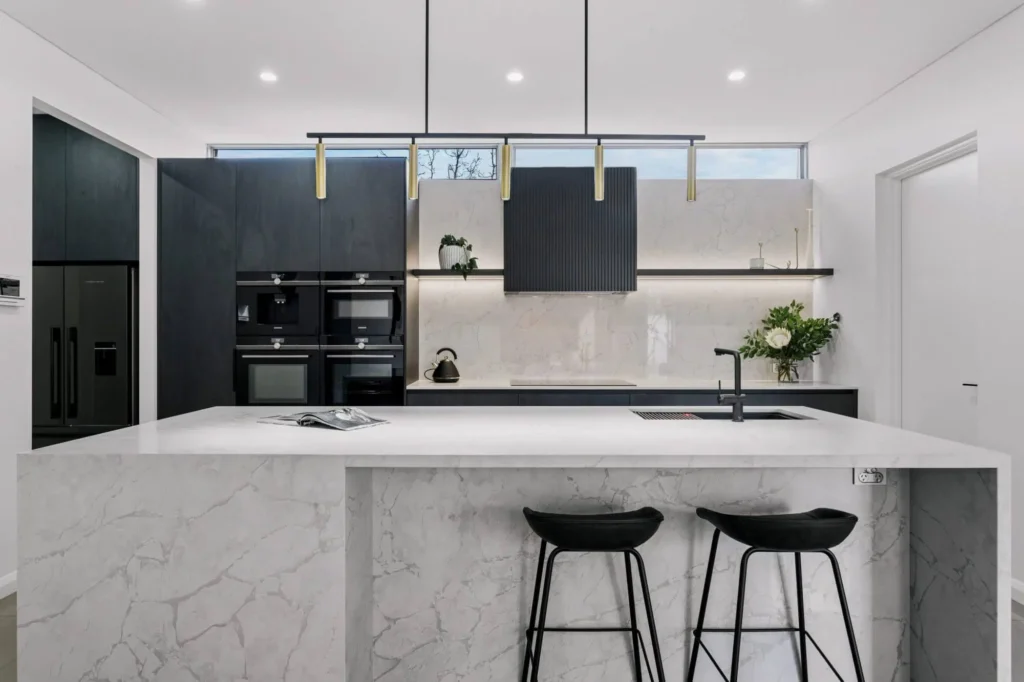

The most convincing entertainer’s kitchen often looks calm while a great deal is happening. Drinks are poured, trays move to the table, dishes collect and guests continue talking without seeing every practical task. This ease is not created by one dramatic appliance. It comes from small planning decisions that reduce crossing, conceal clutter and place each function where it supports the flow of an event.
A useful plan separates the host’s route from the main cooking route. Someone serving drinks should not need to pass behind a person carrying a hot pan. A beverage station near the social area can hold glassware, refrigeration and a small sink, leaving the primary kitchen free for food preparation. In luxury kitchens, this secondary zone may appear as part of the joinery rather than as a separate bar, keeping the room visually consistent.
Landing space is one of the quietest details. Every oven, refrigerator and serving point needs a nearby surface where items can be placed safely. Without it, platters travel further and temporary clutter spreads across the island. A wide clear section near the dining side can act as a handover point between cooking and serving. It should remain free of fixed fittings that restrict how large dishes are arranged.
Storage should follow the event sequence. Table linen, serving pieces and candles belong close to the dining area. Everyday cookware can stay near the cooking zone, while less attractive supplies may sit in a pantry or back kitchen. Deep drawers can make heavy plates easier to reach, but internal divisions should suit the actual collection. Luxury kitchens feel seamless when doors do not need to remain open while the host searches for an item.
Noise also shapes the atmosphere. Extraction, dishwashers, ice makers and refrigeration can interrupt conversation if selected or positioned without care. Product performance varies, so claims should be checked against current specifications and the room conditions. Soft-close hardware, stable shelving and secure glass storage can reduce smaller sounds. Acoustic finishes in the wider room may also help where hard stone, glass and timber create strong reflections.
Lighting needs layers rather than one bright setting. Preparation surfaces require clear task light, but guests may prefer a warmer mood once cooking is finished. Dimming and separate control allow pendants, joinery lighting and ceiling fixtures to change together or independently. Controls should be intuitive enough to use while hosting. A beautiful scene is less useful when it requires several confusing apps or switches.
Waste and cleaning deserve the same attention as display. Bins should be close to preparation and clearing routes, with enough capacity for an event. A second dishwasher or a compact wash-up zone may suit some households, but the decision should reflect real habits and available space. Designers of luxury kitchens often protect the main view by placing dirty dishes in a pantry, scullery or screened section where work can continue out of sight.
Power and charging points should appear where guests and hosts naturally use them, yet they should not interrupt the clean surfaces that make the room feel composed. Retractable or concealed outlets may suit some locations, while fixed wall or island points can be simpler and more reliable. Their position needs coordination with seating, water and appliance zones, and all electrical work should be designed and completed by appropriately qualified professionals.
Ventilation affects comfort during gatherings. Cooking heat can build when doors are closed and many people occupy the room. Extraction should suit the plan, while air movement should not create noise across serving areas. Early coordination keeps these systems discreet.
The final test is to rehearse an evening on paper. Trace how guests arrive, where drinks are made, how food reaches the table and where used plates return. Open doors and drawers on the plan. Mark places where two people meet or a route becomes blocked. When those small conflicts are resolved early, the finished kitchen does not need to show how hard it is working. It simply allows the host to remain part of the occasion.